
Life Insurance Guide (https://lifeinsuranceguide.com.au/) was developed as a consumer-facing resource to help Australians better understand life insurance, the role of advice, and some of the key issues that sit around cover, superannuation, affordability and review.
It is still early days, but it has been interesting to see which topics, articles and tools are attracting attention.
For advisers, this is useful because it gives a small window into the types of questions clients and potential clients may be trying to answer before they ever sit down for an advice conversation.
Clients are looking for simple starting points
Much of the interest on Life Insurance Guide sits around simple but important questions.
Things like:
- How does insurance through super work?
- How much cover might I need?
- When should I review my insurance?
- What does income protection actually do?
- Is default cover enough?
- How do I find an adviser who can help?
These are not always technical questions. More often, they are confidence questions.
People are trying to work out whether the topic matters to them, whether their current cover might be enough, and whether it is worth taking a next step.
That is an important reminder for advisers. Before a client asks about definitions, ownership structures or premium design, they may first be asking a much simpler question:
“Does this apply to me?”
Insurance through super continues to resonate
One of the stronger areas of engagement has been insurance through super.
That is not surprising. Many Australians have some level of insurance inside super, but often have only a limited understanding of what that cover actually means.
They may not be clear on:
- what cover they have
- how premiums are paid
- how premiums may affect their super balance over time
- whether default cover is enough
- what happens if they change jobs or super funds
- whether the cover is appropriate for their needs
The insurance in super interactive calculator has certainly been one of the more popular items on the site, regularly sitting among the higher-traffic resources.
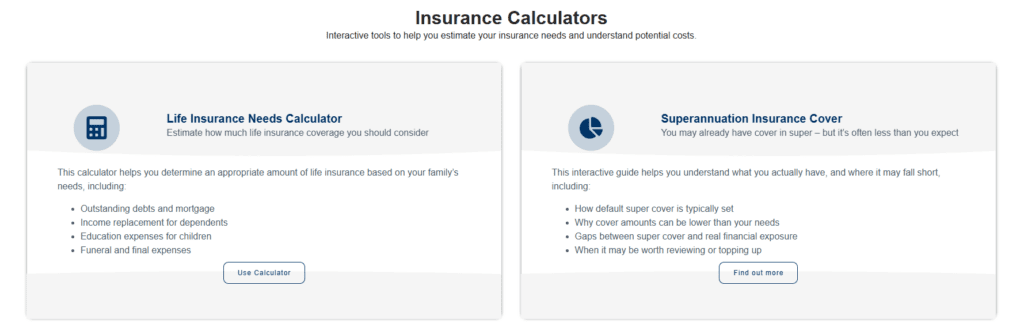
That suggests the topic is not just theoretical. People are interested in understanding how the issue might apply to their own situation.
The calculator is not designed to replace advice. But it can help someone see why the issue may be worth reviewing.
It turns a general concept into a more personal question:
“Could this be affecting me?”
Tools help move people from reading to action
Client education material has always been important.
But increasingly, the value is not just in explaining a topic. It is in helping the client take the next small step.
An article might help someone understand insurance through super. A calculator or checklist can help them think about whether they should do something about it.
That next step might be:
- checking current cover
- using a calculator
- completing a review checklist
- preparing questions for an adviser
- speaking to their super fund
- booking a proper advice conversation
This is where simple interactive tools can be useful.
They are not advice. They do not provide a recommendation. But they can make the issue more tangible and help clients engage with the conversation more confidently.
What advisers can leverage
For advisers, the opportunity is not just to wait for clients to find these resources.
Consumer-friendly content can be used more deliberately as part of client and referral source engagement.
For example, advisers can:
- include a link in review emails
- share a relevant article after a client meeting
- send a calculator to clients who ask about insurance through super
- include a short snippet in a referral partner newsletter
- use a client-friendly article as a LinkedIn post prompt
- add similar tools or explanations to their own website
- use a checklist as a soft call to action
A simple message might be:
If you have insurance through super, this quick calculator may help you understand how premiums can affect your balance over time.
Or:
If you are not sure whether your insurance needs reviewing, this short checklist may give you a useful starting point.
That sort of message is easy for clients to understand, and easy for referral sources to share.
Search is still doing much of the heavy lifting
A lot of Life Insurance Guide traffic is still coming through traditional search, particularly Google, although Edge/Bing is becoming more relevant as search behaviour continues to shift.
AI-assisted search is also clearly becoming part of the landscape, both for Life Insurance Guide and Risk Hub.
That matters because clients and referral sources are increasingly using a mix of search, AI tools and direct recommendations to find answers.
If your content is clear, useful and well-structured, it has a better chance of being found, shared and used.
Adviser search is also gaining traction
Another pleasing trend is that adviser-related search activity is starting to have an impact.
The adviser directory is becoming one of the higher-traffic areas of Life Insurance Guide and continues to grow steadily.

That is encouraging, because the goal is not just to provide information. It is to help consumers find advisers who can support them with proper advice.
For participating advisers, this creates another opportunity to be visible where clients are already looking for guidance.
The broader opportunity
The broader point is that client education works best when it does more than explain.
It should help the client take a small, safe and useful next step.
That might be reading an article, trying a calculator, completing a checklist, preparing for a review, or finding an adviser.
Life Insurance Guide will continue building out consumer-friendly articles, calculators and tools to support those steps. Risk Hub will also continue developing adviser-focused resources that can help practices use this type of material more effectively with clients and referral partners.
Some resources are already freely available, and we are also exploring more brandable options for advisers who want selected tools, content or calculators adapted for their own website, client campaigns or referral source engagement.
If you are interested in being part of the adviser directory, or would like to explore client-friendly tools and content for your own practice, get in touch.