
A guest article by Graham Burnard, Managing Director, Maven Business Strategies
This follows on from the Risk Conversations session with Marc Fabris, Peter Stathis and Graham Burnard, now available on demand [Risk Conversations].
In a world where lead generation has become increasingly expensive and consumers are inundated with marketing messages, there is one constant: people trust recommendations from professionals they already know.
For insurance advisers, this remains one of the best opportunities for sustainable business growth.
There is a sharper reason to care about it now than there was a decade ago. Twenty years back, almost any client who walked through the door and bought life insurance made you money. Compliance was light, commissions were high, and most client relationships were profitable. That is no longer the case. It is now very easy to end up with an unprofitable insurance client, which means you have to be far more selective about who you take on.
Which raises an uncomfortable question. Are the people referring you clear about who you actually want? Or is it still “you need some insurance, go and see Sarah”?
While digital marketing, social media and paid advertising all have their place, few client acquisition strategies deliver the quality, conversion rates and long-term value of referrals from trusted Centres of Influence (COIs). Whether those referrals come from accountants, mortgage brokers, solicitors or wealth-focused financial planners, a well-developed referral network can become the cornerstone of a thriving insurance practice.
The challenge, however, is that referral relationships don’t happen by accident. They require planning, clear positioning and an ongoing commitment to creating value for everyone involved.
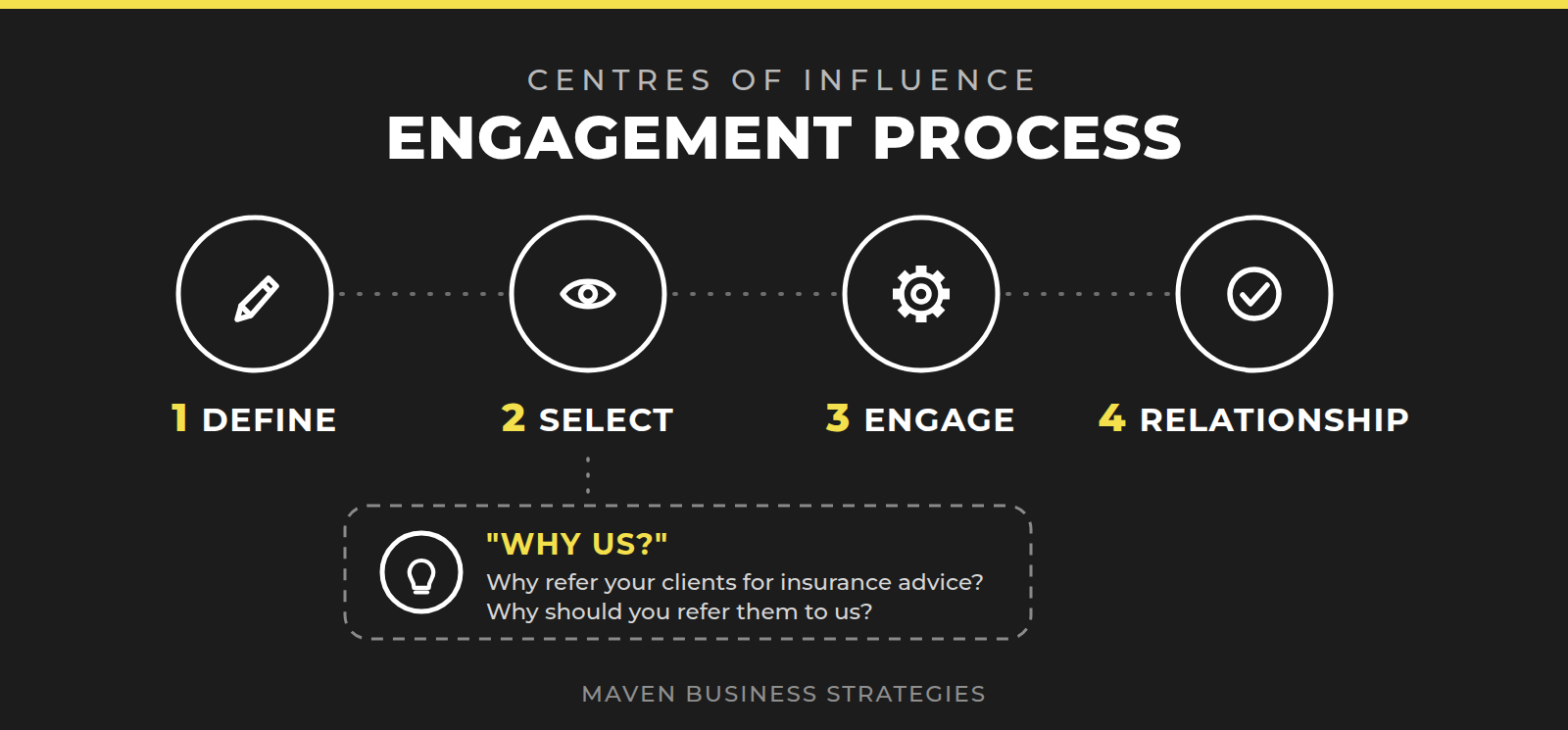
Start by knowing exactly who you want to help
One of the biggest mistakes advisers make is trying to appeal to everyone.
The most successful insurance advisers are remarkably clear about who they serve best. They understand the occupations, life stages, financial circumstances and personal concerns of their ideal clients, and they build their referral strategy around attracting more people who fit that profile.
Rather than simply saying, “I help people with life insurance,” consider defining your niche more precisely.
Perhaps you specialise in:
- Medical specialists with growing families
- Business owners protecting key people and succession plans
- Professionals with large mortgages and young children
- Executives with complex remuneration packages
- Families navigating serious health events
It does not have to be an occupation. Some practices define their ideal client by characteristics instead: clients whose circumstances have genuine complexity, who have sufficient scale to make the work worthwhile, who have real commitments behind the need, and who will value advice enough to pay for it. There is no single right answer, and the useful version is the one that fits how you actually want to work.
When your ideal client becomes crystal clear, choosing referral partners becomes significantly easier. Instead of asking, “Who might send me clients?” you begin asking, “Who already works with the exact people I want to help?”
That subtle shift changes everything.
Choose referral partners strategically
Many advisers adopt what could best be described as a scattergun approach to networking. They attend every breakfast, join every networking group and collect dozens of business cards, hoping referrals will eventually follow.
In reality, a small number of high-quality referral partners will almost always outperform dozens of casual acquaintances.
Think carefully about which professionals naturally encounter clients before major financial decisions are made.
| Professional | What they see |
| Mortgage brokers | Young families taking on significant debt, precisely the time when life and income protection become critically important |
| Accountants | Business owners whose growing wealth has outpaced their personal protection arrangements |
| Solicitors | Estate planning work that frequently uncovers insurance gaps, beneficiary issues and broader financial risks |
| General insurance brokers | Business owners who already understand risk management, making personal risk protection a natural extension |
Rather than attempting to build relationships with everyone, focus on a handful of professionals whose client base closely aligns with your own.
Depth almost always beats breadth.
Understand what’s in it for them
One of the quickest ways to damage a potential referral relationship is making it entirely about your business.
Referral partners aren’t looking for another salesperson asking for introductions. They’re looking for someone who helps them serve their own clients better.
Before talking about your services, invest time understanding their business. Ask questions.
- What challenges do they face?
- What types of clients do they most enjoy working with?
- Where do their clients commonly struggle?
- What opportunities are they trying to create?
Only once you understand their objectives can you position your business as helping achieve them.
For many professionals, the greatest benefit isn’t financial. It’s knowing they have a trusted specialist who will genuinely look after their clients.
Every quality referral reflects directly on the person making the introduction. When their clients have a positive experience with you, it strengthens their own relationship as well.
That’s a powerful motivator. It also reinforces that quality referrals are unlikely to flow without a high level of trust between you and the referrer already being in place.
Give people a reason to recommend you
If a referral partner were introducing you tomorrow, what would they actually say?
Many advisers struggle to answer this question.
“I know a good insurance adviser” isn’t memorable.
Instead, give them the ability to position you as a relevant expert. Perhaps:
“You should speak with Sarah because she specialises in protecting medical professionals and understands exactly how their income structures work.”
Or:
“David works extensively with business owners and helps them protect both their family and their business if something unexpected happens.”
Specificity builds confidence. Your referral partners should immediately understand:
- Who you help
- What problems you solve
- Why you’re different
- Why their clients will benefit from seeing you
If they can’t easily explain your value proposition, they probably won’t refer with confidence.
Educate rather than sell
Many professionals still have an incomplete understanding of modern insurance advice.
Some assume insurance advisers simply compare policies. Others underestimate the strategic role quality personal insurance advice plays in protecting families, businesses and wealth.
Rather than asking immediately for referrals, spend time educating your referral partners.
Share real client stories. This is one of the most powerful ways of demonstrating the impact of having the right insurance in place when it is needed.
- Explain how properly structured cover has protected families following unexpected illness or injury
- Discuss how income protection has allowed a business owner to keep paying themselves through an extended health event, and how business expenses cover kept the practice running alongside it
- Illustrate how appropriate ownership structures and beneficiary arrangements can significantly improve client outcomes
These conversations help referral partners recognise situations where their own clients could benefit from specialist advice. They may even see the need for their own insurances to be reviewed.
Education creates confidence, and confidence generates referrals.
Build advocacy, not transactions
The strongest referral relationships evolve into genuine partnerships.
That means looking for opportunities to help each other’s businesses grow. For example:
- Joint educational seminars
- Client webinars
- Co-authored articles
- Professional development sessions for their staff
- Case study presentations
These activities position both businesses as trusted experts while providing genuine value to existing clients.
Equally important is maintaining regular communication.
Too many advisers meet a potential referral partner once, enjoy a coffee together and then disappear for six months. Relationships don’t grow through occasional catch-ups.
Stay visible by sharing useful articles, industry updates, legislative changes or client education resources relevant to their profession.
Become someone who consistently adds value rather than someone who only appears when seeking referrals.
Make referring easy
Even enthusiastic referral partners sometimes hesitate because they’re unsure exactly when or how to introduce a client.
Help them identify common trigger events. For example:
- A client takes on a significant mortgage
- Someone starts a family
- A business owner hires key staff
- Someone changes employment or becomes self-employed
- A client experiences illness within their family
- A business begins succession planning
The easier you make it for someone to identify an appropriate referral, the more referrals you’ll receive.
Consider giving the referral partner a draft email they could send to the client, copying you in, to make the introduction.
Better still, give them something to hand over. A short client health check, five questions or so, works well because the referral partner never has to be the expert. They simply put it in front of a client, the answers surface a gap, and the introduction becomes obvious to both of them. Accountants and solicitors in particular tend to be comfortable with this, because nothing about it requires them to offer an opinion on insurance.
The principle matters more than the format. Anything that gives your partner a reason to start the conversation, without needing to know the answers, will produce more introductions than asking them to remember you.
Follow through professionally
Nothing builds trust faster than exceptional communication after a referral has been made. Equally, nothing destroys it faster than none at all.
When someone entrusts you with one of their valued clients, they deserve confidence that the introduction was worthwhile.
A simple process can make a significant difference.
- Thank them promptly
- Confirm you’ve contacted the client
- Let them know when the meeting has occurred
- Advise that the matter is progressing, while always respecting client confidentiality and obtaining appropriate permissions where necessary
These updates reassure the referral partner that their client is being well looked after and reinforce your professionalism.
Over time, this consistency builds confidence. Confidence becomes advocacy. Advocacy becomes a steady stream of high-quality introductions.
Build a system, not hope
Referral relationships shouldn’t depend on memory or chance. Treat them as you would any other business development strategy.
Maintain a shortlist of priority referral partners.
Schedule regular contact. Plan out a contact schedule with clear, value-adding reasons to be in touch. Once planned, diarise those contacts so they actually happen.
Track introductions. Over time you will see which COIs are producing the strongest outcomes and why. Nurture those relationships even further.
Measure conversion rates. This is the best indication of the quality of the referrals coming through. A low conversion rate might mean the wrong people are being referred, or it might be the way you are being recommended. Once you have the data, you are far better placed to diagnose the problem.
Most importantly, continue investing in the partnerships that create value for everyone involved.
The most successful insurance advisers rarely rely on one outstanding referral source. Instead, they cultivate several strong professional relationships that consistently generate quality opportunities year after year.
By taking a proactive and measured approach, you build a reliable foundation for ongoing growth.
The bottom line
Centres of Influence remain one of the most effective growth strategies available to insurance advisers.
Not because they’re quick. Not because they’re easy. But because they’re built on trust.
When you clearly define your ideal client, partner with professionals who serve the same people, create genuine value for those partners and consistently demonstrate your expertise, referrals become far more than occasional introductions.
They become a predictable, scalable source of high-quality new business.
None of this is rocket science. It is a simple, structured process and a commitment to doing the work. Do the homework, have the conversations, and don’t just hope for the best.
In an environment where it is increasingly difficult to create profitable client relationships, this can be your most effective source of business growth.
Want the account plan template?
Graham has offered to share the one-page account plan he uses with practices to structure their approach to each target firm. Email him at graham@mavenbusiness.au for a copy.

About the author
Graham Burnard is Managing Director of Maven Business Strategies, where he works with financial advice businesses on growth, sales and client engagement. Over twenty years he has helped owners get clear on what they want their business to be, then build the structure and habits to get there. His background combines senior corporate leadership in financial services with hands-on consulting to advice practices.
mavenbusiness.au