
Over the past little while, I’ve been spending some time working on a couple of tools aimed at smoothing out parts of the risk advice process.
The idea didn’t come out of nowhere. Through various Risk Hub surveys and conversations with advisers, a few themes keep coming up. Certain parts of the process are still more cumbersome than they probably should be.
Two in particular stand out.
Not because they’re especially complicated, but because the tools available often just don’t cut it for risk advice.
The first is running a needs analysis that’s easy to work through and easy for clients to understand.
The second is collecting clean client data before the meeting, rather than spending half the conversation gathering basic information.
Both of these issues come up regularly when speaking with advisers.
So rather than just talking about them, I decided to build something practical that might help.
Two tools have come out of that work:
- the Risk Needs Calculator, and
- the Client Data Hub.
They’re separate tools and can be used independently, but they also fit naturally alongside each other in the advice process.
Here’s a quick overview.
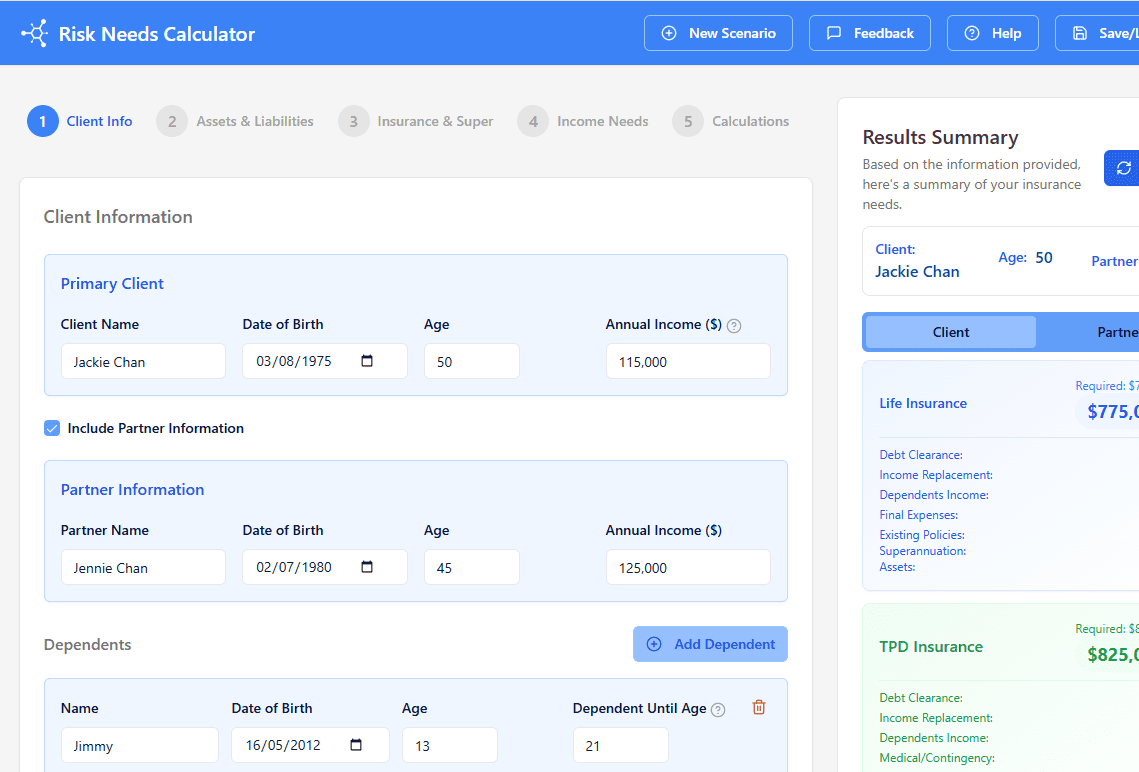
Risk Needs Calculator
Built with advisers in mind – https://riskneedscalc.com.au
The Risk Needs Calculator has been in development for quite a while. That’s actually been a good thing. It’s meant the logic and calculations have been tested and refined through real client scenarios.
This isn’t a generic online calculator built without understanding how risk advice actually works. It’s been shaped with adviser input, and designed specifically for the way risk advice conversations actually happen.
The aim was to create something that is simple enough to use in a real client meeting, but flexible enough to support different adviser approaches and house views.
Assumptions can be adjusted, different components can be included or excluded, and scenarios can be changed easily as the conversation evolves.
One of the things advisers have liked most is the clean one-page summary. It helps clients see how the numbers come together and makes the discussion far more tangible.
The tool also allows you to:
- Save cases and return to them later
- Adjust calculation assumptions where needed
- Export the data to use in other tools or documents
- Produce a clear summary you can use in client discussions
And yes, before anyone says it – this isn’t designed to become another system your data gets stuck in. The data can be exported easily, and the outputs are structured in a way that works well with other tools (including AI workflows if you’re heading down that path).
The core calculator is free to use, with no time limit.
Pro access unlocks unlimited case saving, PDF and CSV exports, JSON export for integrations, and the downloadable one-page summary report.
Pro access is $29 per month + GST or $290 per year + GST.
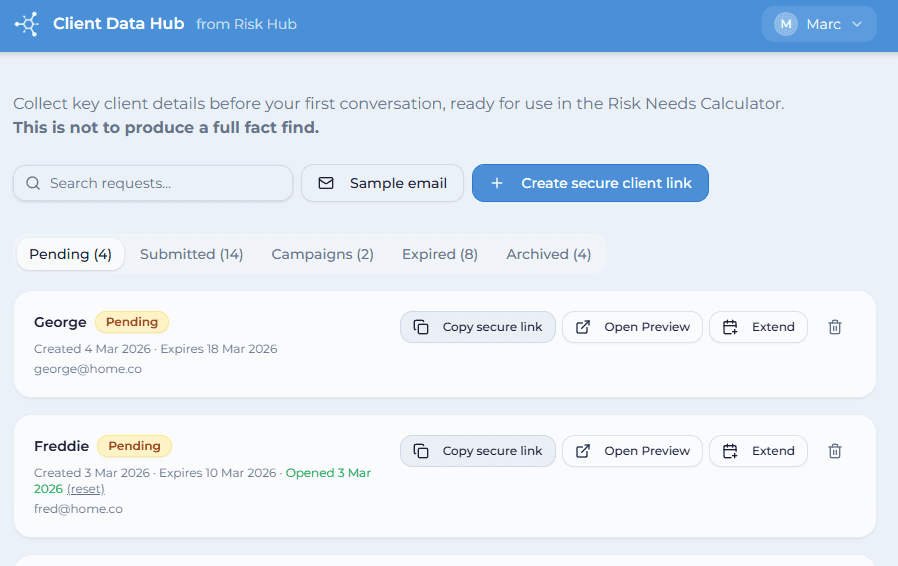
Client Data Hub
Getting the basics before you meet – https://clientdatahub.com.au/
The second tool tackles another common friction point in the early stages of risk advice – collecting good client data.
Many advisers still find themselves gathering basic information during the meeting, or re-keying details from emails, forms, or notes.
Client Data Hub is designed to make that first step easier.
You generate a secure link and send it to your client before the meeting. They complete a short guided form covering key information such as personal details, income, assets, existing insurance, superannuation, and a basic health background.
When they submit the form, the information appears in your adviser dashboard where you can review it, make any minor adjustments, and export the data if needed.
Importantly, the form is intentionally kept lean. It’s not designed to replace a full fact find. The aim is simply to capture enough information to start a meaningful needs analysis conversation without overwhelming a client before you’ve even met them.
Client Data Hub is $29 per month + GST or $290 per year + GST.
Using them together
While the tools are separate, they work particularly well together.
A typical workflow might look like this:
- The client completes the Client Data Hub form before the meeting.
- The adviser reviews the submission in the dashboard.
- The data can be exported and imported directly into the Needs Calculator.
- The adviser runs the needs analysis and prepares the summary for the discussion.
The result is a smoother start to the advice process, less time spent re-keying information, and a clearer conversation with the client about their financial risks and protection needs.
Feedback welcome
Both tools will continue to evolve based on how advisers actually use them.
If you do have a play with either of them, I’d genuinely value hearing your thoughts. What works well, what feels clunky, or what you’d like to see added.
You can drop us a note anytime at info@riskhub.com.au.
And while these two tools focus on needs analysis and early-stage data collection, there’s more work underway looking at other parts of the advice process as well.
More on that soon.
Marc Fabris
Risk Hub